XOT (Gothic Runik English) Language:

- The Younger Fuþark. Danish long branch, swedish/norweigan short twig and latin letters.
“Xot” stands for a people [see “Goths are not Pagans“] & as a language. Xot as a language is a spiritualized English for a northern European spiritual tradition, that is unfolding in the “NOW”. Xot does this by reinvigorated Modern English by re-connecting ancient RUNIK and modern Xotik (Gothic/Germanic) elements in a kind of Jungian Alchemical Cauldron. It is important to remember that Deutsch (German) and English, as does many of the other Languages in Europe, have the same roots in the UrXotik (Germanic) Family. The earliest Xotik texts are third century AD runic inscriptions. Slowly as Rome and especially Judeo-Christianity merged with the Xotik People they introduced Latin as a means to further their power over the Xots. The Xot Language is a reversal of this “Spiritual Colonization” so that it can better express the “Xoting” (spiritual unfoldment) towards “XotHood” (cosmic consciousness, enlightenment) in the NOW.
CAPITALS
One feature of Xot is that as in Deutsch (German) it capitalizes it’s Nouns which we will do from now on in this Page, that is Capitalize all Nouns.
Being revised.
CASES
Another Feature is that Xot reinvigorates the Cases in English using Deutsch Elements.
“r” stands for the Subjective Case as in “dur Boy” (the boy)
“n” stands for the Objective Case as in “Dur Boy reads dun Bok.” (The boy reads the book)
“m” stands for the Dative Case as in “Dur Boy reads dun Bok in dum House.” (The boy reads the Book in the House)
“s” stands for the Possessive Case as in “Dur Boy reads dun Bok dus Father in dum House.” (The boy reads Father’s Book in the House)
VOWELS
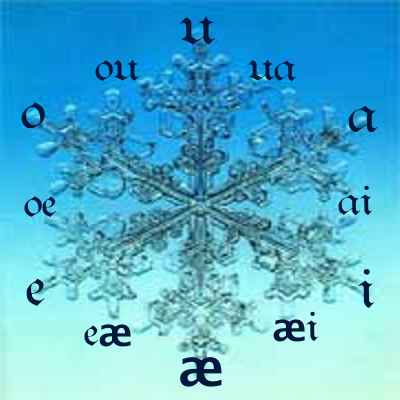
rr09 Voweled Snowflake
A main Feature of Xot-English is that it uses the Six Primary Runik Vowels as indicators of States of Consciousness especially in it’s Pronouns and Articles. Like a Snowflake or the Structure of Water the Vowels create a VISUAL HEX. When they are voiced they are an ORAL HEX or a HEX XALDOR. When the Vowels are single they are Short Vowels. When they are doubled they are Long Vowels. It is important to Remember these act as Point of Views (POV). These Vowels indicate the POV that the Author wants the Reader to understand the Word in.
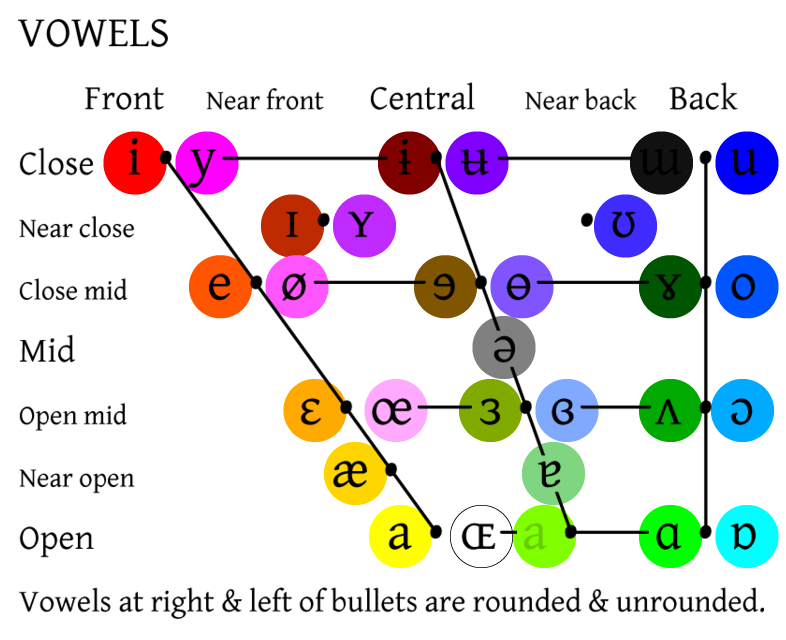
IPA VOWELS IN COLOR
[I:] – [u:]
[e:] – [o:]
[ae] – [ɒ]
HOD STATES (/hod/ from hood as in neighborhood, Godhood, meaning states of consciousness)
u [u] stands for dun Du-State, dun Physical State
– [u:] as in cool, Luke, pooled, Fool.
a [ɒ̹] stands for dan Da-State, dan Dream / Emotional / Archetype State
– [ɒ] as in hot, awsome, Xot, caught, God
i [i] stands for din Di-State, din Simple/Robotic State
– [I:] as in see, me, to be, free
æ [æ] stands for dæn Dæ-State, dæn Reflective / Concentration / Dharana State
– [ae] as in fat, Cat, at, Bat
e [e] stands for den De-State, den No-Thought/ Synchronicity/Dhyana State
– [e:] as in May, play, eh, Fable.
[o] stands for don Do-State, don Holistic State / Xothood / Samadhi State
– [o:] as in old, Joe, sold, Soul.
NOTE: u, a, o, are “round Vowels” pronounced with the Mouth Open and Round. i, æ, e are “smiling Vowels” pronounced with the Mouth in a Smile
see also FUTHARK RUNIK XALDOR
LONG VOWELS: Long vowels emphasize what you are experiencing or have experienced. Although we may experience several things in a Sentence we may want to emphasize only one experience in that Sentence.
EXAMPLES:
“dur Boy” means the Physical Boy.
“uner Boy” means a Physical Boy.
“duur Boy” means the Experiential Physical Boy that we are seeing or have seen.
“dar Boy” means the Dream Boy. It is used mainly when we are talking about Dreams but could also have the Connotation of a “Dream Boy”. If we want the Reader to understand we actually mean a Dream, we are having or have had, we could say “daar Boy”.
“aaner Boy” means a Experiential Physical Boy that we are seeing or have actually seen.
“dir” Boy means the Boy, the Boy which we might not really put much thought to.
FOREIGN WORDS:
As in any Language Xotik English has indigenous Words & Foreign Words.
A rule of Thumb in Xotik English is that it uses Runik Letters for indigenous Words & leaves foreign Letters for foreign Words. Since this Language is still evolving the Writing and Posts are not consistent at this Time.
“c” becomes “k” as in “runic becomes “Runik”
“g” becomes “x” as in “gotic” becomes “Xotik”, “Goting” becomes “Xotinx”, “ground” becomes “xround” but “language” stays “Language” because it comes from Latin. “foreign” also remains “foreign because it comes from Latin.
Any Comments, Corrections or Questions for Clarification are welcome.
*NOTES:
- -hood

- word-forming element meaning “state or condition of being,” from Old English -had “condition, position,” cognate with German -heit, Dutch -heid, all from Proto-Germanic *haidus “manner, quality,” literally “bright appearance,” from PIE (s)kai- “bright, shining.” Originally a free-standing word (see hade); in Modern English it survives only in this suffix.
godhood [ˈgɒdˌhʊd] n
(Christianity / Ecclesiastical Terms) the state of being divine
Collins English Dictionary – Complete and Unabridged © HarperCollins Publishers 1991, 1994, 1998, 2000, 2003
- language (n.)
- late 13c., langage “words, what is said, conversation, talk,” from Old French langage (12c.), from Vulgar Latin *linguaticum, from Latin lingua “tongue,” also “speech, language” (see lingual). The form with -u- developed in Anglo-French. Meaning “a language” is from c.1300, also used in Middle English of dialects:
Mercii, þat beeþ men of myddel Engelond[,] vnderstondeþ bettre þe side langages, norþerne and souþerne, þan norþerne and souþerne vnderstondeþ eiþer oþer. [John of Trevisa, translation of Bartholomew de Glanville’s “De proprietatibus rerum,” 1398]

- foreign (adj.)
- mid-13c., ferren, foreyne “out of doors,” from Old French forain “strange, foreign; outer, external, outdoor; remote, out-of-the-way” (12c.), from Medieval Latin foranus “on the outside, exterior,” from Latin foris “outside,” literally “out of doors,” related to for1s “door,” from PIE *dhwor-ans-, from root *dhwer- “door, doorway” (see door). Spelling altered 17c. perhaps by influence of reign, sovereign. Replaced native fremd. Sense of “not in one’s own land” is first attested late 14c.

