Latest Entries »

To believe your Spiritual Discipline is superior is Fools Gold. —Tiwaz 20120907-2315 rr17-iaa Transcendental

Every Spiritual Tradition has it’s own Dynamics. What may see UnTrue from our Tradition may have inen Spiritual Integrity in another Tradition that escapes our Knowledge. “One Man’s Poison is another Man’s Food.” “One Man’s Fool is another Man’s Food.” Our Mothers are “Superior” to other Mothers because she gave us Birth. Our Home Team is superior because it is our Home Team.

Silence-To-Be, Enlightenment, Cosmic Consciousness, Dharmakaya, Samadhi, Tao etc. etc etc are separate, relative & can be compared from dæm Æ-Stead POV (immanent state point of view) but from dem E-Stead POV (transcendental state point of view) they can be dim Same and both these POV can be also True at dim Same Time. Dær best Approach is thru Deep Respect that “Dir Impossible is just one Possibility”

MIND

Old English gemynd ‘memory, thought’, of Germanic origin, from an Indo-European root meaning ‘revolve in the mind, think’, shared by Sanskrit manas and Latin mens ‘mind’. –Oxford

late 12c., from O.E. gemynd “memory, remembrance, state of being remembered; thought, purpose; conscious mind, intellect, intention,” P.Gmc. *ga-mundiz (cf. Goth. muns “thought,” munan “to think;” O.N. minni “mind;” Ger. Minne (archaic) “love,” originally “memory, loving memory”), from PIE root *men- “think, remember, have one’s mind aroused,” with derivatives referring to qualities of mind or states of thought (cf. Skt. matih “thought,” munih “sage, seer;” Gk. memona “I yearn,” mania “madness,” mantis “one who divines, prophet, seer;” L. mens “mind, understanding, reason,” memini “I remember,” mentio “remembrance;” Lith. mintis “thought, idea,” O.C.S. mineti “to believe, think,” Rus. pamjat “memory”).

Meaning “mental faculty” is mid-14c. “Memory,” one of the oldest senses, now is almost obsolete except in old expressions such as bear in mind, call to mind. Mind’s eye “remembrance” is early 15c. Phrase time out of mind is attested from early 15c. To pay no mind “disregard” is recorded from 1916, American English dialect. To have half a mind to “to have one’s mind half made up to (do something)” is recorded from 1726. Mind-reading is from 1882.
mindset (n.)
also mind-set, “habits of mind formed by previous experience,” 1920, in educators’ jargon, from mind (n.) + set (v.).
mind (v.)
mid-14c., “to remember, take care to remember,” also “to remind,” from mind (n.). Meaning “perceive, notice” is from late 15c.; that of “to give heed to” is from 1550s; that of “be careful about” is from 1737. Sense of “object to, dislike” is from c.1600; negative use (with not) “to care for, to trouble oneself with” is attested from c.1600. Meaning “to take care of, look after” is from 1690s. Related: Minded; minding. Meiotic expression don’t mind if I do attested from 1847. —
http://www.etymonline.com/index.php?allowed_in_frame=0&search=mind&searchmode=none

“The problem is not enjoyment; the problem is attachment.” –Tilopa
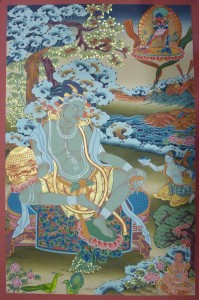
Six Words of Advice

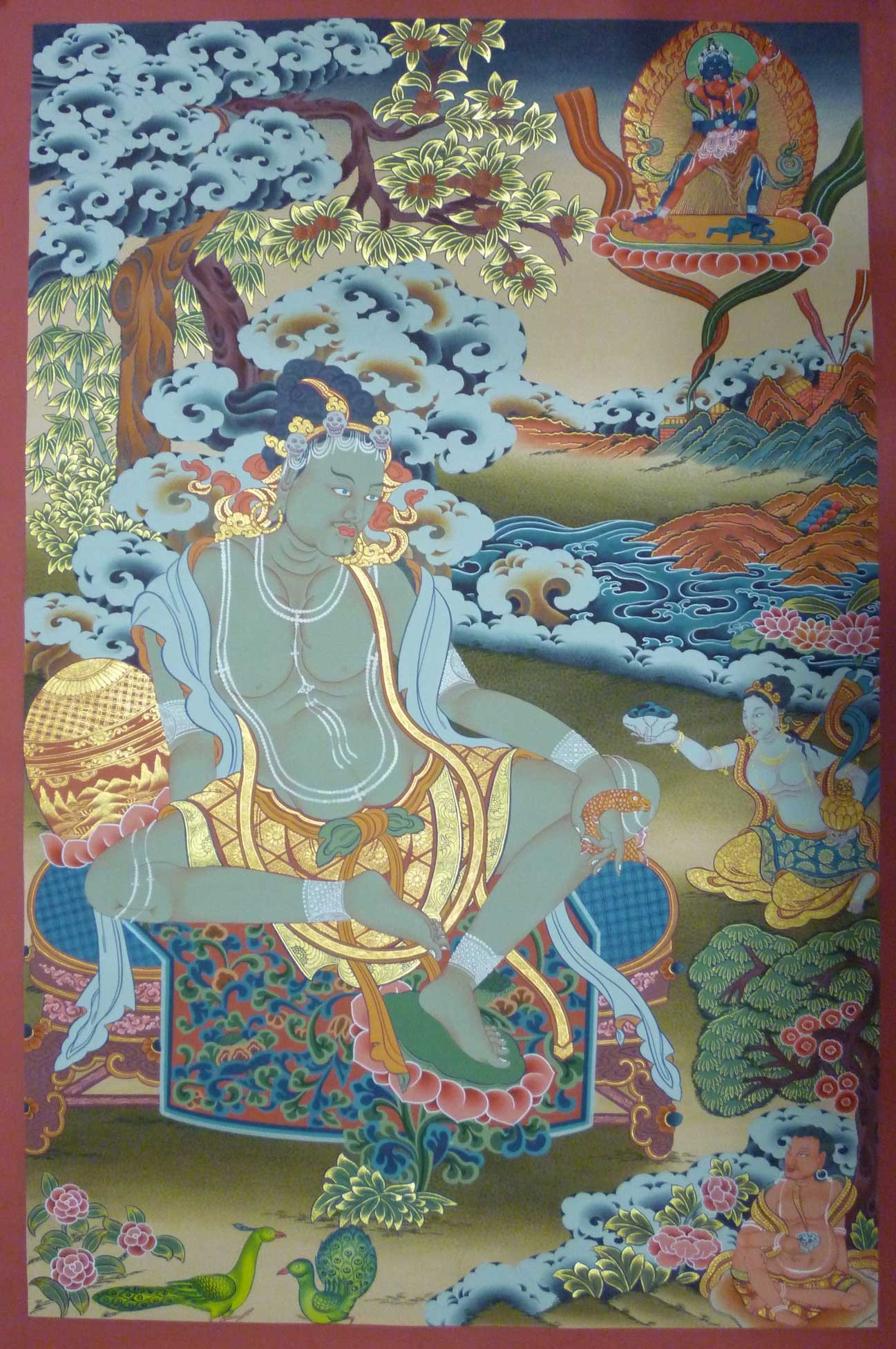
Tilopa gave Naropa a teaching called the Six Words of Advice.

Six Words of Advice
Short Long Tibetan
1 UN- RECALL Let go of what has passed mi mno
2 UN- IMAGINE Let go of what may come mi bsam
3 UN- THINK Let go of what is happening now mi shes
4 UN- EXAMINE Don’t try to figure anything out mi dpyod
5 UN- CONTROL Don’t try to make anything happen mi sgom
6 REST Relax, right now, and rest rang sar bzhag

EXCERPTS FROM: http://www.kagyu.org/kagyulineage/lineage/kag02.php

[Color & Annotation added]]

TILOPA WAS BORN THE KING of a province in India. Although as a king he had always possessed wealth and title, his mind was not completely satisfied, and he left his kingdom to find a teacher of the Dharma [Xoting]. He searched India in all directions for such a master.

….

… Tilopa went to the northern part of the country to practice the Dharma. There he obtained teachings from the dakinis [Valkyrie] and went to meditate in a cave. After making a commitment to meditate there for twelve years, he chained both his legs together so he would not be able to come out of the cave. In this way he meditated for twelve years.

After twelve years passed, the chains that were tied around Tilopa’s legs broke of themselves; he had achieved some realization as a result of his diligent meditation but had not yet accomplished the ultimate realization of Vajradhara. He wished to go out and wander and lead the simple life of a siddha.

However, the dakinis were hesitant to let Tilopa leave his cave and his practice. As it was not proper for him to disobey, he thought he would try to influence them by demonstrating his realization. He picked up a fish in his hand and transferred its consciousness out of its body. The dakinis witnessing this saw that he was a highly realized being and gave him permission to wander as a simple siddha, just as he wished. …

… Tilopa was given instructions to go to a certain village to seek out a woman there who was a prostitute and to work for her. The woman worked during the day making oil out of sesame seed and worked at night as a prostitute. As he was instructed, he worked for the woman during the day by pounding sesame seed, and during the night by soliciting her customers. In this way Tilopa lived as the prostitute’s helper.

One day as Tilopa was pounding sesame seeds in the village, he realized ultimate buddhahood, the Vajradhara aspect of enlightenment. As a sign of his achieving complete realization, Tilopa levitated to the height of seven royal palm trees while still holding a mortar and pestle in his hands and continuing to grind sesame seeds. The news that Tilopa hovered in the air at the height of seven royal palm trees quickly spread through the village.

When the prostitute who employed Tilopa heard that someone was levitating very high in the sky, she hastened to see who it was. To her surprise she discovered that it was her employee in the sky, and that he was still working for her, even as he hovered, by continuing to grind sesame seeds with a mortar and pestle. She felt ashamed to have given such work to a highly realized being, and with great regret, she confessed this to Tilopa and requested him to accept her as his student. As she mentally made this request, Tilopa threw a flower down to her from the sky. The flower hit her on the head, instantaneously causing her to reach complete realization. She then levitated to the same height as Tilopa.

So once again, the news went out and quickly spread among a great number of people. When the news reached the king, he went out himself to witness the blessed event along with all his people. With everyone assembled below, Tilopa sang a song of the Dharma, using the example of the sesame seed in his teaching. In his song, Tilopa explained that although a sesame seed contains oil, it cannot produce oil by itself; without the hard work of grinding the seed, the oil cannot be extracted. So although buddha nature is within every living being, without the hard work of practicing the Dharma, there is no way to realize our inherent buddha nature.

As Tilopa sang this song, the king and all his people immediately understood his teaching and came to complete realization. At the instant of their enlightenment, the village appeared to be momentarily empty of all its inhabitants.

After that day, Tilopa became very famous. His great renown came about not only because of his profound realization, but also because, as he sang in many of his songs, he had no human guru. This was to show that he had received his transmission directly from the Vajradhara aspect of enlightenment.

This teaching on the Life of Tilopa was given by Khenpo Karthar Rinpoche at KTD, Woodstock, NY, March 25-30, 1986. It was translated by Chojor Radha, and edited by Tina Armond.
long for the endless immensity of the sea

“If you want to build a ship, don’t drum up people together to collect wood and don’t assign them tasks and work, but rather teach them to long for the endless immensity of the sea.” –Antoine de Saint-Exupéry rr15-Elhaz

inspiration

Protected: Satyananda’s Vama Marga 1980 – Excerpts

This content is password-protected. To view it, please enter the password below.

We are defined & live by our Thoughts like Addictions.

No one, who has purchased their Thoughts from Books, Newspapers, TV, etc or got them for Free, likes to hear that these Thoughts are Propaganda, Deceptions & Lies. We are defined & live by our Thoughts like Addictions. We need them, we need to show them, to our Peers thru TALK, iTunes & FaceBook that they are proof that we are worth something. The MSM, Alternative Media or FaceBook etc., are the Stock Markets that give our Thoughts Value. And as the Media puts Value or takes Value out of them, we gain or lose Value as Persons. The first Step towards getting rid of this Addiction to Consumer Thoughts is to admit that we are addicted, to Propaganda, Deceptions & Lies. The 2nd Stage is to STOP LYING TO THE PEOPLE WE LOVE! The 3rd Stage is to start a Program of Spiritual Disciplines that will help us realize that we are not our Thoughts.

 Religious men are and must be heretics now — for we must not pray, except in a “form” of words, made beforehand — or think of God but with a prearranged idea..

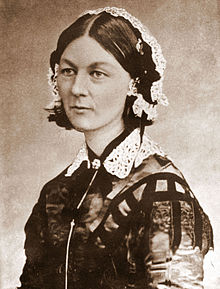
— Florence Nightingale (12 May 1820 – 13 August 1910) was a British nurse, a pioneer of modern nursing, and a noted statistician.

Florence Nightingale (12 May 1820 – 13 August 1910) by H Lenthall

On are Death we breath out. On are Birth we breath in. This is den Secret des Eternal Return of #rr12-Jera.

WORD

A chance word, upon paper, may destroy the world. –William Carlos Williams

Every Word is an Hex, an Spell, an Program. Who controls Words controls Thoughts. Who controls Thoughts control Actions. By controlling your Words you will be able to control your Actions. When you hone your Words you hone your Thoughts. Become dor Programer not dun Programed.

When we begin to understand dam Power das Words we will begin to appreciate dam Power das Runes. When we say Odin is dan Master das Runes we mean he is don Master dos No-Thoughts. By mastering dom Xoting, we can master our  No-Thoughts & therefore master our Actions. When we become Master dos Runes we become Master dis Actions.

word Look up word at Dictionary.com

O.E. word “speech, talk, utterance, word,” from P.Gmc. *wurdan (cf. O.S., O.Fris. word, Du. woord, O.H.G., Ger. wort, O.N. orð, Goth. waurd), from PIE *were- “speak, say” (see verb). The meaning “promise” was in O.E., as was the theological sense. In the plural, the meaning “verbal altercation” (as in to have words with someone) dates from mid-15c. Word processor first recorded 1970; word processing is from 1984; word wrap is from 1977. A word to the wise is from Latin phrase verbum sapienti satis est “a word to the wise is enough.” Word of mouth is recorded from 1550s.

It is dangerous to leave written that which is badly written. A chance word, upon paper, may destroy the world. Watch carefully and erase, while the power is still yours, I say to myself, for all that is put down, once it escapes, may rot its way into a thousand minds, the corn become a black smut, and all libraries, of necessity, be burned to the ground as a consequence. [William Carlos Williams, “Paterson”]


E-Xoting (Dhyana), practiced together with Æ-Xoting (Dharana) and O-Xoting (Samādhi) constitute dæn Æ-E-O-Xoting (Samyama). Æ-E-O-Xoting is an good Substitution for “Meditation”.