UPDATED VERSION AT “XOT Goth”
http://www.tiwaz.com/blog_xoting/xot-goth/
============================================
TIDE TO HEX YOUR ROOTS
Words (Xot-Spell <God Spell < Gospel ) have Power!
Modern English has a Judeo-Christian Point of View (POV) which is important for Judeo-Christians to keep their Spiritual Integrity but makes it difficult to express anything outside it’s POV.

\
A blind love for your own religion, is not just a characteristic of the Abraham religions of Judaism, Christianity, Islam, etc but a characteristic of most religions. In its most basic form we see it in the “tribalism” of sports. The English, Italians or Germans don’t passionately cheer for their Soccer Team and boo everyone else because they are the best, but because they are English, Italian or German. We love our Parents and not the Parents of our Neighbors, not because our Parents are the Best but because they gave us life. This is true of our Religion. We love our Religion and believe it is best not because it is the Best but because it gave us life. In Xot-English we take a Xoto-Khristian (X-K) POV not because it is the “Best” but because it gives us life.
From a Jungian POV we can see that Judeo-Christian POV has a Shadow that it projects onto Outsiders. This is true when it uses the word Pagan1. Many People, in the Alternative Traditions, think of themselves as “pagans”. The Latin Term “paganus” is a Christian adaptation of the word “gentile” of Judaism, and as such has an inherent Abrahamic POV, and pejorative connotations in the Judeo-Christian English language. In classical Latin it means “villager, rustic, civilian,”. Judeo-Christianity was an Urban Movement mainly amongst the alienated, anomic2 (“servus”)3 Thralls4 brought to serve Romans in the Cities. In contemporary Terms “paganus” could be characterized as the “City Slickers” looking down on the Folks from the Country and calling them “Farmers”, Red Necks and Hillbillies. To call the High Civilizations of Greece, Rome, Egypt, India, China, etc as Pagan is not only disrespectful but fundamentally wrong. They called themselves Greeks, Romans, Egyptian, etc.5 Something so simple escapes English Speaking People’s Understanding because of this Judeo-Christian POV in Modern English.
Unlike Judaism, Christianity did not remain racial but was propagandized to d “Multi-Cultural” “Slaves” in Urban Roman Areas. In other words it started off as a racial Religion for Jews and then became a Religion for “servus” who had become alienated from their Indigenous Religions, when they had been taken away from their Homeland. Instead of being rooted in their Ancestors they now worshiped a Rabbi nailed to a Cross. They where told that they where now d True Jews & were propagandized to believe that this Rabbi sacrificed himself so that he could purge d “servus”‘s Guilt of being born in Sin. This Idea of sinning carried over to d Slavery in d Americas. Afro-Americans where told they were Black because they had sinned. By believing in Christ they could be saved.
D Indigenous People of Rome, Greece or Northern Europe did not call themselves “Pagans” & they did not see themselves living in Sin. Two thousand years Ago in Northern Europe, they called themselves XOTS (Goths) d same Way English, French, Germans, etc called themselves Europeans.
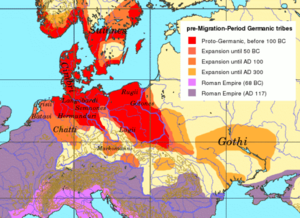 Territories inhabited by East Germanic tribes between 100 BC and AD 300.

“Classical ethnography applied the name Suevi to many Germanic tribes.1 In a similar fashion the appellation “Gothic” constantly gained in importance until the sixth century. As soon as late antique ethnographers noticed common elements of language, way of life, or geographical origin,2 they spoke of “Gothic peoples.3 … The name Goths, which replaced that of Scythians, embraced the most diverse Germanic and even non-Germanic peoples: the Goths in Italy, the Vandals, the Goths in Spain, the Gepids, Rugians, Sciri, and Burgundians, indeed, even the Alans.5 The common faith and law, the lex Gothica,6 and the common language were the most important reasons for lumping these peoples together. On linguistic grounds, for the purposes of classification, modern scholarship invented the artificial term East Germanic peoples, which is today commonly used.7″ 6
“From ancient times the Teutons have been known as a group of people who speak the Germanic group of languages. Some prefer the term “Teutonic” over “Germanic” to avoid the confusion between the words “Germanic” and “German.” But in reality the terms “Teutonic” and “German” mean the same thing. The term “Gothic” has even been applied to the whole of the Germanic realm, although this too originally referred to only one branch of the Germanic family. Today any of these three terms, Germanic, Teutonic, or Gothic, may refer to the overall tradition of this original group. ….”7
——————–
The Mysteries of the Goths BY EDRED ( Edred Thorsson)
ISBN: 1-885972-31-8 Runa-Raven Press P. O. Box 557 Smithville, Texas 78957 USA
….

Johannes Bureus (1627)
…
16th and 17th century obsession with the idea of the Goths especially prevalent in Scandinavia and England. This obsession even has a name— Gothicism, “Gothicism” or Storgoticism, “Megleoi-Gothicism.” This movement and its chief esoteric exponent, Johannes Bureus, is the subject of a fine study by Thomas Karlsson, Adulruna and the Gothic Cabbala. These early modem Gothic enthusiasts felt hey had discovered the font of all civilization in the ancient Goths. Later in the 18th and 19th centuries Romantics throughout Europe began to identify themselves as “Gothic.” The word was applied to all Germanic peoples— Germans, Anglo-Saxons, as well as all {pp 11} Scandinavians.
…
The Name “Goth“
The name of the Goths is shrouded in mystery. This mystery is only enhanced and deepened by the long history of the name. … One of the main problems is that there were in antiquity a number of different groups and subgroups of whose names were similar, but not identical, to the name of the Goths.
Tradition has it that they are named after their most distant ancestor, Gaut(s). Some might agree that this eponymous name ws projected back to a myth, however, the probable meaning of the name Gauts issomething like “father.” There is an Icelandic heiti, or byname, of O∂inn— Gautr. This element also occurs in the Old Icelandic Rune-Poem in the stanza for áss ([god]= O∂inn): Ass er aldin-gautr, “God is the ancient father.” For more on this poem, see The Rune Poems (Runa-Raven, 2002). This does not necessarily mean that Gauts is identical with Wo∂anaz, because the name only means “father,” in the etymotological sense of of “he who pours out,” i.e. the generations or offspring.
From ancient times the name of the Goths appears in a grammatically strong and weak form, Gut- and Guton- respectively. [17] Beyond this there is also the fact that the name appears in Greek and Latin as well as Gothic orthographies. Tradition would hold that this name and that contained in the name of Gotaland (Gotland) in present day Sweden and the island of Gotland stem from the same source and that these are identical to the Geatas (ON Gautar) in Beowulf.
This name later became confused with others. The principal confusion came in connection with the name of a Dacian tribe, the Getae, who inhabited present-day northern Romania at the time the Goths settled there for a short while in the 4th century. These names were then confused by Latin and Greek writers. Through the centuries, as the fame of the Gothic name spread, any similar sounding name came to be identified as “Goth,” including the Jutes [yootes] of the North Sea and even the Judaei [yood-ah-ey], “Jews.” … The link between the name of the Goths and that of the Jews will play a part in some medieval mysteries surrounding the Goths.
… This can be demonstrated with the description of a single well-known word: PGmc. tiwaz, the name of the sky-god and the name of the 17th rune in the Older Fupark. In EGmc. (Gothic) this is teiws, in NGmc. tiwaR and in SGmc. we find Old High German ziu or Old English tiw. … These technical linguistic details may seem tedious, but they provide some [18] important clues for determining the interactions of various tribes in ancient times and help us to identify certain artifacts of esoteric Importance.
In the tribal histories of the Germanic peoples these linguistic designations are also important because they show which tribes shared deep common roots. The East Germanic tribes were, besides the Ostrogoths and Visigoths, the Vandals, the Burgundians, the Gepids and the Rugians. The original homeland of the Burgundians was the island of Bornholm in the Baltic. The Erulians, or Heruli, have also sometimes been classified with the East Germanic “tribes,” but their classification remains problematic. Runic inscriptions in the Older Futhark show that rune-carvers identifying themselves as “Erulians” did not use East Germanic linguistic form, e.g. ek erilaR. It is most likely that the Hrulians were an intertribal band of oath-bound warriors made up of members of various Germanic tribes.
…
———————
Modern Terms
Another important implication of the bias against “pagan” is its rise to modern movements like Wicca. They believe that they are worshiping something other than Christianity but really what they are doing is worshiping the dark side of Christianity. This “opposite” is still Christianity defined by Christianity. Greeks, Romans, Goths did not define their Religion as opposite to Christianity. It was defined within itself and like the Abrhamic bias probably defined everything outside itself as condescending and in pejorative terms.
Other Modern Terms have been coined like Asatru (Faith in the Gods), Odinism, Heathenry & Forn Sidr (the Ancient Custom). These Terms have similar Problems that the Word Pagan has. They focuses on what is described as historical Norse paganism of the Viking Age. Norse Paganism is described as a subset of Germanic paganism which reaches back to the IRON AGE of the 11th century BC! How Pagan can you get?
How far the Xoting really goes is arguable but we can safely say it goes back to at least to the Time of the Elder Futhark of d 1st-2nd century BC. It must be stressed d Xoting focuses on the Mystical Eternal Return of dus Goths of 2,000 years Ago re-Birthing in the Now. In other Words think of these Other Terms basing their Definition on Causality of Linear Time while d Xoting is based on a kind of Consciousness of Space where the Elder Futhark is the Bulls Eye of a Black Hole and the Circumference is the synchronistic rippling of an Eternal Now.
EXCERPT FROM: WHAT IS ASATRU? — http://www.odinsvolk.ca/O.V.A.%20-%20ASATRU%20INTRO.htm Asatru is a somewhat modern term in Old Norse. Asatru is an Icelandic translation of the Danish word Asetro. This word was invented in the early 19th century by scholars studying the Norse Germanic pagan religion and folk beliefs along with the Eddas and Sagas. The earliest use of the term Asatru that anybody has so far able to find was its use in a song written by Norwegian composer Edvard Grieg. It was written around 1873 as part of the third scene of Grieg’s opera Olav Trygvason, of which only the first act – the Heathen one – was ever written. But the word was coined sometime before that, earlier around the 1820s, as part of the Scandinavian Romantic movement. The term Asatru became official when the religion was recognized by the Icelandic government in 1972 at the urging of the poet, Sveinbjorn Beinteinsson. Today the term refers to the re-birth of the ancient ethnic pre-Christian religion of northern Europe in its modern manifestation.
If dur Xots of Northern Europe saw a Man nailed to a Cross they would worship him as Odin & that dur Name Christ, Jesus or Joshua was just another one of his countless Names.
Xot-Spells
In the beginning was the Word: the Word was with God [[Xot]]. and the Word was God. — John the Gospel 1:1 [[Gospel = Xot-Spell8]]
Modern Movements calling themselves “Pagan” shows a profound lack of Knowledge of History & even, a more profound lack of understanding of d Power of Xot-Spells.
Who ever controls your Words, control your Thoughts. Who ever control your Thoughts control your Actions. –Tiwaz
By replacing d “Pagan” Spell with d”Xot” Spell, People of European Roots will use this new SPELL to reveal their True Spiritual Home.
Gote-Gott-Goth-GOD! Dur Sound we associate with “G” is written in dum Elder Futhark as “X”. Uner Xot ist anyone who is impregnated with Mimir – Xotik (Gothic) Blood Memory – consciously or unconsciously. These Mimirs go back Thousands if not Hundreds dus Thousands dus Years. Dur Aristocracy dus Northern Europe before dum Judeo-Christian Colonialization traced their Progenitors to Xots (Gods), Thor (Thur-s-day), Frigg (Fri-day), Tiwaz (Tue-s-day), etc. What we see Today in dam Gothic Scene is oumer RESURRECTION!
- 1– pagan

- late 14c., from L.L. paganus “pagan,” in classical Latin “villager, rustic, civilian,” from pagus “rural district,” originally “district limited by markers,” thus related to pangere “to fix, fasten,” from PIE base *pag- “to fix” (see pact). Religious sense is often said to derive from conservative rural adherence to the old gods after the Christianization of Roman towns and cities; but the word in this sense predates that period in Church history, and it is more likely derived from the use of paganus in Roman military jargon for “civilian, incompetent soldier,” which Christians (Tertullian, c.202; Augustine) picked up with the military imagery of the early Church (e.g. milites “soldier of Christ,” etc.). Applied to modern pantheists and nature-worshippers from 1908. –from etymonline.com/
2 – ANOMIE: The word comes from Greek, namely the prefix a- “without”, and nomos “law”. The Greeks distinguished between nomos (νόμος, “law”), and arché (αρχή, “starting rule, axiom, principle”). For example, a monarch is a single ruler but he or she might still be subject to, and not exempt from, the prevailing laws, i.e. nomos. In the original city state democracy, the majority rule was an aspect of arché because it was a rule-based, customary system which might or might not make laws, i.e. nomos. Thus, the original meaning of anomie defined anything or anyone against or outside the law, or a condition where the current laws were not applied resulting in a state of illegitimacy or lawlessness.Etymology: From French anomie, from Greek anomia (lawlessness), from anomos (lawless),from a- (without) + nomos (law). Ultimately from the Indo-European root nem- (to assign or take) that’s also the source for words such as number, numb, nomad, metronome, astronomy, and nemesis.
- 3 – slave (n.)
- late 13c., “person who is the property of another,” from O.Fr. esclave (13c.), from M.L. Sclavus “slave” (cf. It. schiavo, Fr. esclave, Sp. esclavo), originally “Slav” (see Slav), so called because of the many Slavs sold into slavery by conquering peoples. (Xot tries not use the Word “Slave” (Slav) because its a pejorative Connotations for Slavic People.)
- 4 – thrall
- O.E. þræl “bondman, serf, slave,” from O.N. þræll “slave, servant,” probably from P.Gmc. *thrakhilaz, lit. “runner,” from root *threh- “to run” (cf. O.H.G. dregil “servant,” prop. “runner;” O.E. þrægan, Goth. þragjan “to run”).
5 – “there is no pagan philosophy, inasmuch as anything “pagan” is always still something Christian —the counter-Christian, The Greek poets and thinkers can hardly be designated as “pagan.”” –Heidegger [[from Heidegger’s Nietzsche ISBN-0060638419 ]]
- 8– gospel
- O.E. godspel “gospel, glad tidings announced by Jesus; one of the four gospels,” from god “good” (see good) + spel “story, message” (see spell(n.)); translation of L. bona adnuntiatio, itself a translation of Gk. euangelion “reward for bringing good news.”The first element of the O.E. word had a long “o,” but it shifted under mistaken association with God. The word passed early from English to continental Germanic languages in forms that clearly indicate the first element had shifted to “God,” e.g. O.S. godspell, O.H.G. gotspell, O.N. goðspiall. Used of anything as true as the Gospel from mid-13c. Gospel-gossip was Addison’s word (“Spectator,” 1711) for “one who is always talking of sermons, texts, etc.” –from etymonline.com/