“The problem is not enjoyment; the problem is attachment.” –Tilopa
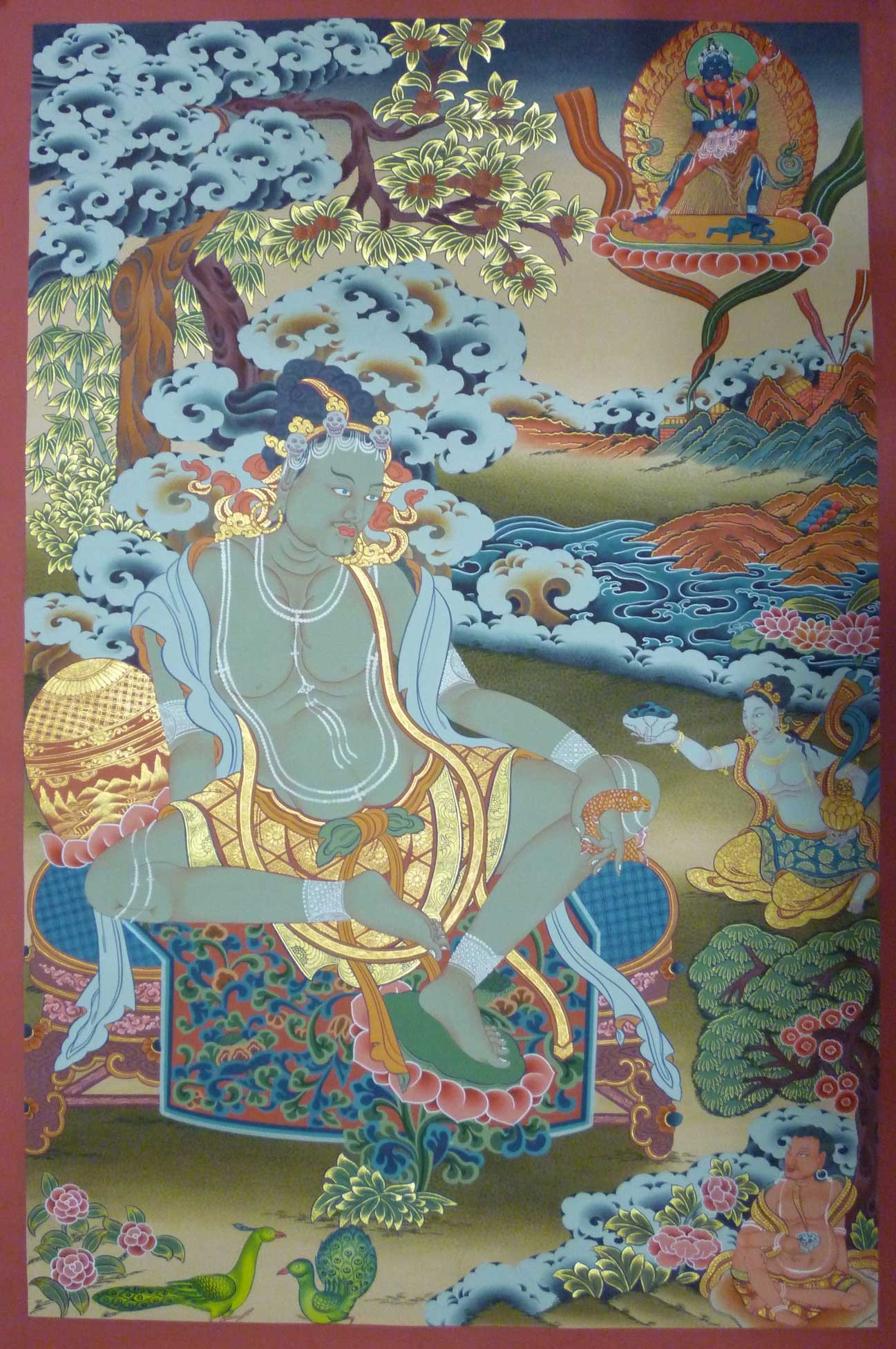
Six Words of Advice
Tilopa gave Naropa a teaching called the Six Words of Advice.
| Short | Long | Tibetan | |
|---|---|---|---|
| 1 | UN- RECALL | Let go of what has passed | mi mno |
| 2 | UN- IMAGINE | Let go of what may come | mi bsam |
| 3 | UN- THINK | Let go of what is happening now | mi shes |
| 4 | UN- EXAMINE | Don’t try to figure anything out | mi dpyod |
| 5 | UN- CONTROL | Don’t try to make anything happen | mi sgom |
| 6 | REST | Relax, right now, and rest | rang sar bzhag |
EXCERPTS FROM: http://www.kagyu.org/kagyulineage/lineage/kag02.php
[Color & Annotation added]]
TILOPA WAS BORN THE KING of a province in India. Although as a king he had always possessed wealth and title, his mind was not completely satisfied, and he left his kingdom to find a teacher of the Dharma [Xoting]. He searched India in all directions for such a master.
….
… Tilopa went to the northern part of the country to practice the Dharma. There he obtained teachings from the dakinis [Valkyrie] and went to meditate in a cave. After making a commitment to meditate there for twelve years, he chained both his legs together so he would not be able to come out of the cave. In this way he meditated for twelve years.
After twelve years passed, the chains that were tied around Tilopa’s legs broke of themselves; he had achieved some realization as a result of his diligent meditation but had not yet accomplished the ultimate realization of Vajradhara. He wished to go out and wander and lead the simple life of a siddha.
However, the dakinis were hesitant to let Tilopa leave his cave and his practice. As it was not proper for him to disobey, he thought he would try to influence them by demonstrating his realization. He picked up a fish in his hand and transferred its consciousness out of its body. The dakinis witnessing this saw that he was a highly realized being and gave him permission to wander as a simple siddha, just as he wished. …
…
… Tilopa was given instructions to go to a certain village to seek out a woman there who was a prostitute and to work for her. The woman worked during the day making oil out of sesame seed and worked at night as a prostitute. As he was instructed, he worked for the woman during the day by pounding sesame seed, and during the night by soliciting her customers. In this way Tilopa lived as the prostitute’s helper.
One day as Tilopa was pounding sesame seeds in the village, he realized ultimate buddhahood, the Vajradhara aspect of enlightenment. As a sign of his achieving complete realization, Tilopa levitated to the height of seven royal palm trees while still holding a mortar and pestle in his hands and continuing to grind sesame seeds. The news that Tilopa hovered in the air at the height of seven royal palm trees quickly spread through the village.
When the prostitute who employed Tilopa heard that someone was levitating very high in the sky, she hastened to see who it was. To her surprise she discovered that it was her employee in the sky, and that he was still working for her, even as he hovered, by continuing to grind sesame seeds with a mortar and pestle. She felt ashamed to have given such work to a highly realized being, and with great regret, she confessed this to Tilopa and requested him to accept her as his student. As she mentally made this request, Tilopa threw a flower down to her from the sky. The flower hit her on the head, instantaneously causing her to reach complete realization. She then levitated to the same height as Tilopa.
So once again, the news went out and quickly spread among a great number of people. When the news reached the king, he went out himself to witness the blessed event along with all his people. With everyone assembled below, Tilopa sang a song of the Dharma, using the example of the sesame seed in his teaching. In his song, Tilopa explained that although a sesame seed contains oil, it cannot produce oil by itself; without the hard work of grinding the seed, the oil cannot be extracted. So although buddha nature is within every living being, without the hard work of practicing the Dharma, there is no way to realize our inherent buddha nature.
As Tilopa sang this song, the king and all his people immediately understood his teaching and came to complete realization. At the instant of their enlightenment, the village appeared to be momentarily empty of all its inhabitants.
After that day, Tilopa became very famous. His great renown came about not only because of his profound realization, but also because, as he sang in many of his songs, he had no human guru. This was to show that he had received his transmission directly from the Vajradhara aspect of enlightenment.
This teaching on the Life of Tilopa was given by Khenpo Karthar Rinpoche at KTD, Woodstock, NY, March 25-30, 1986. It was translated by Chojor Radha, and edited by Tina Armond.